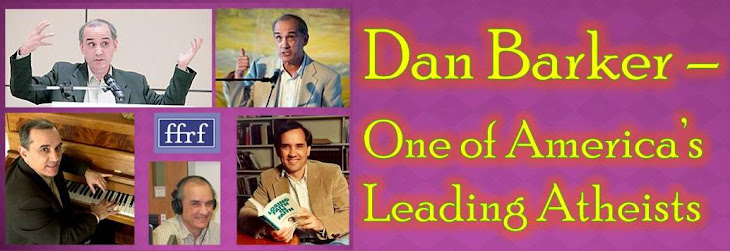
This is part one of an eight part essay responding to Dan Barker and the Freedom From Religion Foundation (hereinafter FFRF). I will be considering their “Nontract” #11 “What Is A Freethinker?” [1] "THE WEBMASTER", Atheism — What It Is, and What It Isn’t - American Atheists
This segment serves as the Introduction.
IntroductionPart 1: Introduction
Part 2: “How do freethinkers know what is true?”
Part 3: “Do freethinkers have a basis for morality?”
Part 4: “Do freethinkers have meaning in life?”
Part 5: “Doesn't the complexity of life require a designer?”
Part 6: “Why are freethinkers opposed to religion?” and “Hasn't religion done tremendous good in the world?”
Part 7: “Do freethinkers have a particular political persuasion?” and “Is atheism/humanism a religion?”
Part 8: “Why should I be happy to be a freethinker?” and “How can I support freethought?”
The first answer to the question “What Is A Freethinker?” at least according to the Barkerian Sect’s definition, is that the concept and term “Freethinker” is oxymoronic. As we shall see, this particular, and peculiar, sect are a rigidly controlled group who follow authoritarian dogma.
One answer to the question offered in the tract is as follows:“A person who forms opinions about religion on the basis of reason, independently of tradition, authority, or established belief.”
According to this definition I and many people of whom I am aware are Freethinkers.
Although, “established belief” is a tricky term. Does it mean that if a belief has been established on the basis of reason, independently of tradition or authority I cannot hold to the belief and at the same time be a Freethinker? What if atheism is considered an “established belief” would I not be able to be both a Freethinker and an atheist at the same time? Apparently I could since the next sentence states,“Freethinkers include atheists, agnostics and rationalists.”
Incidentally, while, as we shall see, Dan Barker and the FFRF have a very dogmatic and authoritarian definition of that a “Freethinker” is this conflicts with American Atheist webmaster’s dogmatic and authoritarian definition of that an “atheist” is:“Atheists are NOT ‘secular humanists’, ‘freethinkers’, ‘rationalists’ or ‘ethical culturalists’…Often, people who are Atheists find it useful to masquerade behind such labels.”[1]
Non-theism’s various sects often excommunicate each other in their zealous proselytizing.
It is interesting to note that Dan Barker wrote:“No one can tell you what to think. Not your teachers. Not your parents. Not your minister, priest, or rabbi. Not your friends or relatives. Not this book. You are the boss of your own mind. If you have used your own mind to find out what is true, then you should be proud! Your thoughts are free!”
It would appear that one thing missing form the above statement is “No one can tell you what to think. Not even Nontract #11” since this tract is rigidly dogmatic as exampled in the following authoritative pronouncement:“No one can be a freethinker who demands conformity to a bible, creed, or messiah. To the freethinker, revelation and faith are invalid, and orthodoxy is no guarantee of truth.”
Freethough is though which is contained within a narrowly defined parameter of assertions, presuppositions and anathemas. In a latter section of the tract we learn that with regards to morality:“Individuals are free to choose, within the limits of humanistic morality.”
FYI: this blog is now in stasis.
Posts regarding atheism are being posted to Atheism is Dead
I am also maintaining a Christian apologetics blog: Life and Doctrine
I also have three other side projects:
Christian Apologetics – Pagination - this one provides feeds from apologetics, theology and contra atheism related blogs. Also provides resources such as books, audio, video, DVDs, t-shirts, etc.
Intelligent Designs - this one is my Cafepress online shop where you can purchase Christian apologetics and contra atheism related t-shirts, postcards, etc.
My Flickr site - this one contains various images and illustrations which anyone is free to copy and use.
Monday, December 8, 2008
Freethought Without Forethought?, part 1 of 8
Subscribe to:
Post Comments (Atom)

1 comments:
“No one can tell you what to think. Not your teachers. Not your parents. Not your minister, priest, or rabbi. Not your friends or relatives. Not this book. You are the boss of your own mind. If you have used your own mind to find out what is true, then you should be proud! Your thoughts are free!”
Isn't he telling us what to think in that statement? You should think this way: Don't let anyone tell you what to think, not even me. If you don't think that way you aren't thinking properly. What if I came to the conclusion that I needed to think a different way or that there is a standard for thinking higher than myself? Would I still be a freethinker?
Also, How is it that a thought can be genuinely free in an atheistic worldview? It would seem that if a thought is simply the result of a long complex non-rational chain of chemical and material causes and effects then a thought isn't really free at all, it is just an effect determined by the conditions. Given those same conditions a human being will always have that thought. How can they blame Theists for having different biological conditions that produced different effects?
Post a Comment