This segment serves as the “Why should I be happy to be a freethinker?” and “How can I support freethought?”.
Part 1: Introduction
Part 2: “How do freethinkers know what is true?”
Part 3: “Do freethinkers have a basis for morality?”
Part 4: “Do freethinkers have meaning in life?”
Part 5: “Doesn't the complexity of life require a designer?”
Part 6: “Why are freethinkers opposed to religion?” and “Hasn't religion done tremendous good in the world?”
Part 7: “Do freethinkers have a particular political persuasion?” and “Is atheism/humanism a religion?”
Part 8: “Why should I be happy to be a freethinker?” and “How can I support freethought?”
“Why should I be happy to be a freethinker?”
This seems like an odd question, which is answered thusly:
“Freethought is reasonable. Freethought allows you to do your own thinking. A plurality of individuals thinking, free from restraints of orthodoxy, allows ideas to be tested, discarded or adopted. Freethinkers see no pride in the blind maintenance of ancient superstitions or self-effacing prostration before divine tyrants known only through primitive ‘revelations.’ Freethought is respectable. Freethought is truly free.”
Psychology is certainly not my field and yet, I am fascinated by people who make such diligent attempts at denying that which they most certainly are. The first parts of the tract refute this latter part, as we have very clearly seen—the tract is internally inconsistent.
“How can I support freethought?”
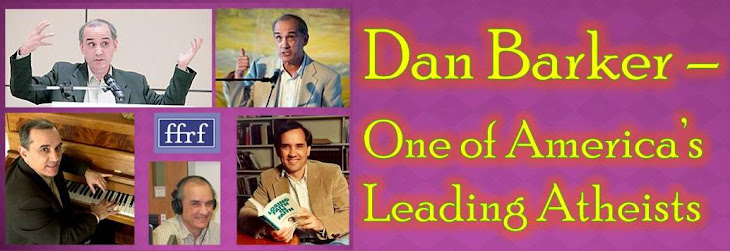
Like any good tract (yes, I jest) this one ends with the atheist evangelist pleading for money and an invitation to convert “Join the Freedom From Religion Foundation, Inc.”
One claim made in this section is that part of the mission of the FFRF is “to educate the public about the views of nontheists.” I have written various essays that, sadly, demonstrate that Dan Barker and the FFRF are either unwilling or simply incapable of providing accurate information about what nontheists, in particular Judeo-Christian ones, believe.
They are simply not fit to take on the role of educators with regards to the views of nontheists, at least the Judeo-Christian ones. However, their publications are very useful as a study aid in understanding pseudo-skepticism, poor, lazy or non-existent scholarship, belligerent belittling besmirchment, and irrational illogical argumentation.
Continue reading Freethought Without Forethought?, part 8 of 8...